Who acquires Helicobacter pylori in the United States—and when? Age at infection by race, ethnicity, and birthplace
Under revision — Helicobacter
Who Acquires H. pylori in the US, and When?
Edward Hopper — Nighthawks (1942) Art Institute of Chicago · Chicago
The Problem
Helicobacter pylori is the primary risk factor for gastric cancer, and its prevalence in the United States varies dramatically across racial and ethnic groups. Yet we lack estimates of the force of infection (the rate at which susceptible individuals become infected) stratified by race, ethnicity, birthplace, and birth cohort. Without these estimates, public health interventions cannot be targeted where they are needed most.
The Approach
We developed a hierarchical Bayesian catalytic epidemic model using seroprevalence data from two nationally representative NHANES cycles (1988–1994 and 1999–2000). The model estimated age-specific prevalence and force of infection for four racial and ethnic groups (Hispanic, non-Hispanic Black, non-Hispanic White, and other races) while incorporating sex, birth cohort, and place of birth as covariates. The hierarchical structure pooled information across groups, yielding stable subgroup-specific estimates even for smaller populations.
What We Found
25,000 Individuals surveyed
90% Max prevalence
Childhood Peak force of infection
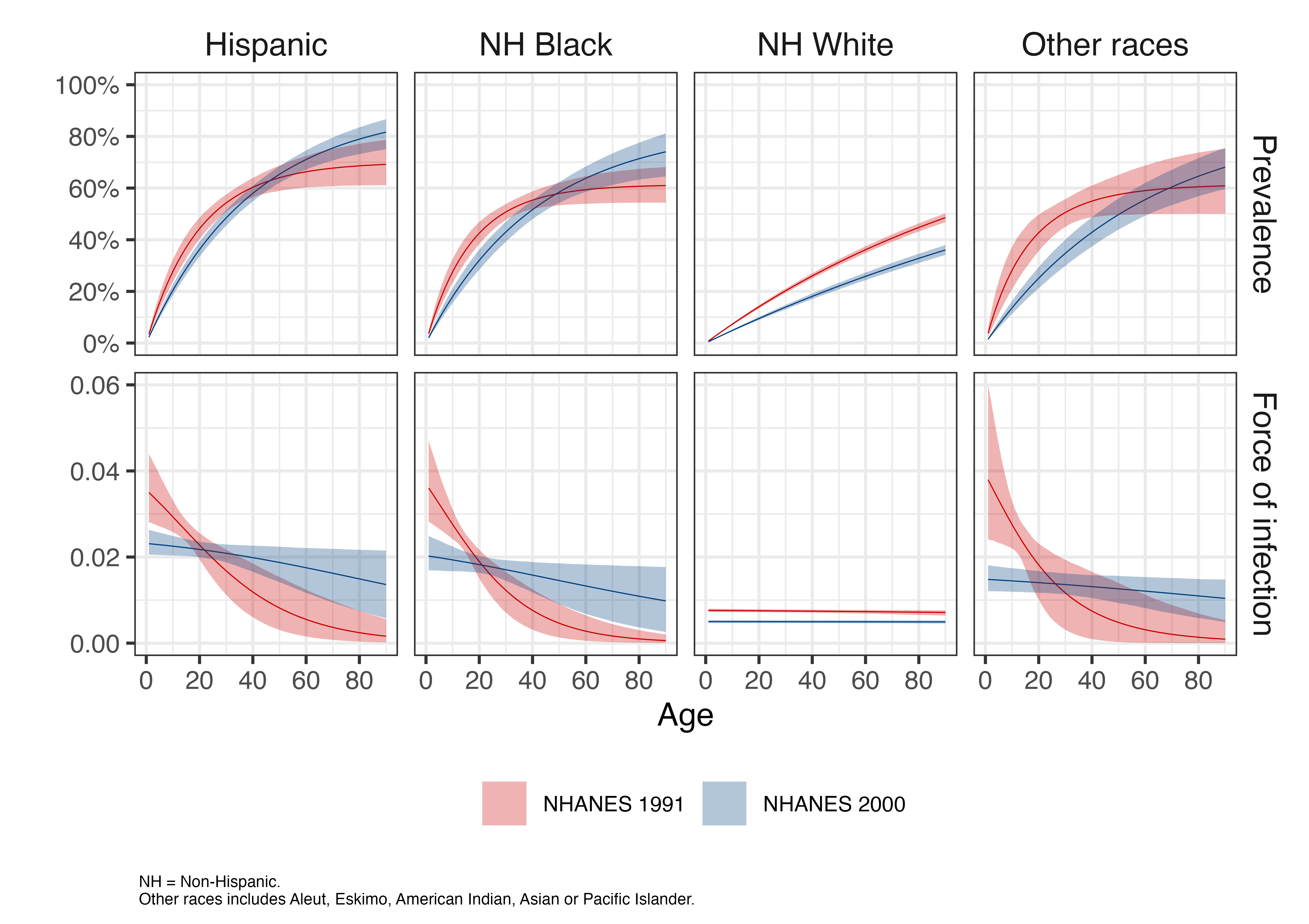
The force of infection peaked sharply in early childhood (before age 10) and declined rapidly thereafter across all groups. Hispanic and non-Hispanic Black populations had the highest FOI peaks (0.04–0.05 infections/person/year), roughly double the rate among non-Hispanic Whites (0.02–0.03). Foreign-born individuals reached maximum prevalence near 90% by age 90, compared to 40–70% among US-born individuals. Between NHANES cycles, FOI decreased, particularly among Hispanic and non-Hispanic Black populations, indicating reduced transmission in more recent cohorts. No significant differences by sex were observed.
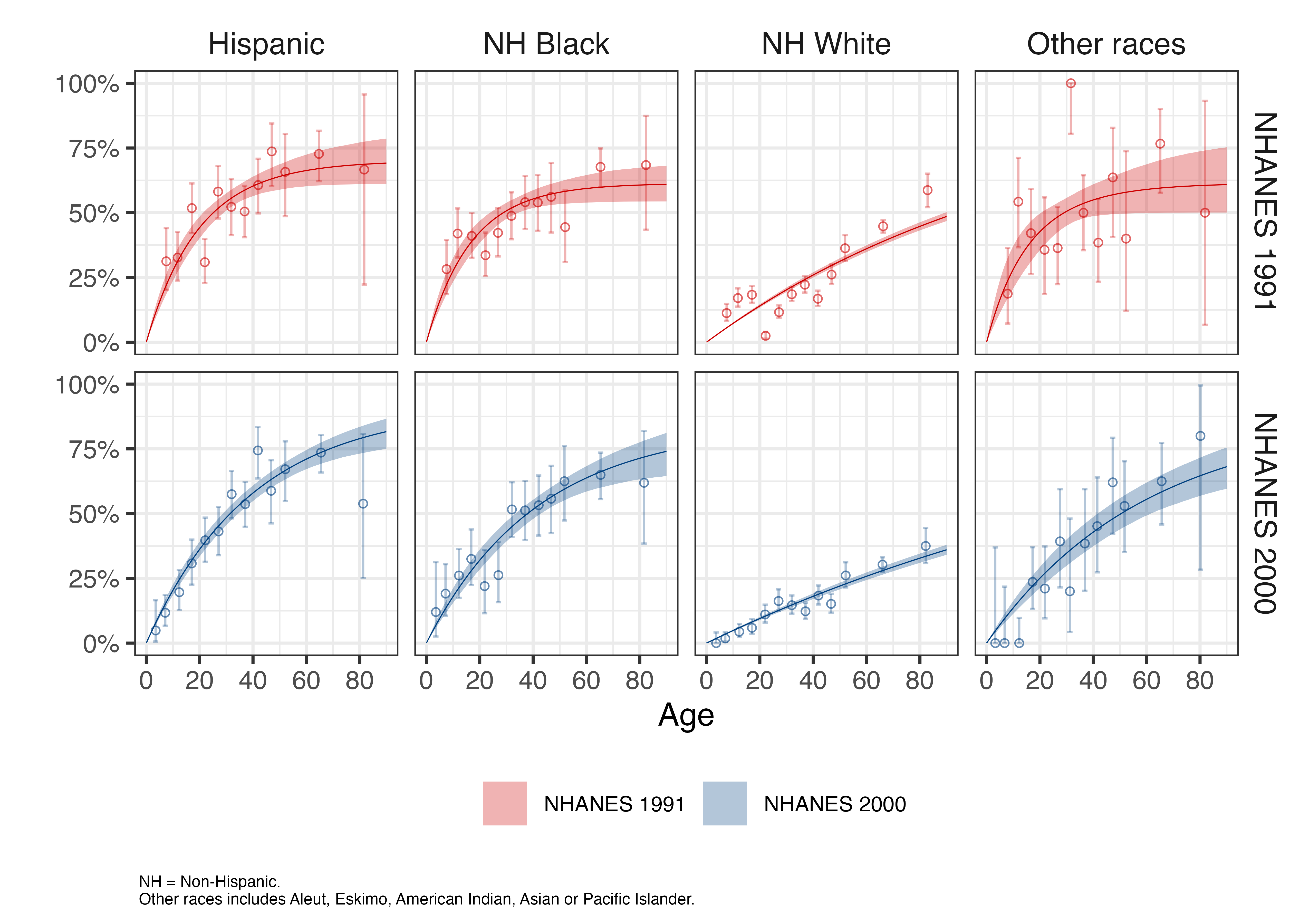 Estimated weighted seroprevalence of H. pylori by age, race, and NHANES cycle (Bayesian catalytic model). NH = non-Hispanic.
Why It Matters
Early childhood is the critical window for H. pylori transmission, and the force of infection is substantially higher among Hispanic and non-Hispanic Black populations. These race-specific estimates can guide targeted prevention strategies, particularly among foreign-born and minority communities that carry the greatest burden of infection and, ultimately, gastric cancer.
Cite This Work
Note: The SSRN preprint was posted in 2025 under an earlier title.