La geografía de la violencia: presencia de grupos criminales en México
Animal Político — El Dispensario
The Geography of Violence: Criminal group presence in Mexico
Édouard Manet — The Execution of Emperor Maximilian (1867) Kunsthalle Mannheim · Mannheim
Using a database assembled from over 150 sources, the op-ed documents 148 distinct criminal organizations operating across Mexico, a figure that exceeds official DEA counts. It also finds that CJNG alone operates in 31 of 32 states. The data expose a counterintuitive finding: the states with the highest concentration of criminal groups are not always the most violent, suggesting that the structure and brutality of competition matter more than the count of organizations.
The problem
How many criminal groups operate in Mexico? It is the kind of question whose answer ought to be easy to look up, and isn’t. No public, comprehensive database systematically maps the presence of criminal organizations across all 32 federal entities. U.S. sources like the DEA document only the groups with operational footprints in the United States, missing the smaller, regional, and splinter organizations that drive much of the country’s localized violence. The result is a national security debate fought largely in the dark: officials, journalists, and citizens reason about where and who without a shared empirical baseline.
The CIDE Programa de Política de Drogas (PADeCI) set out to fix that gap.
The approach
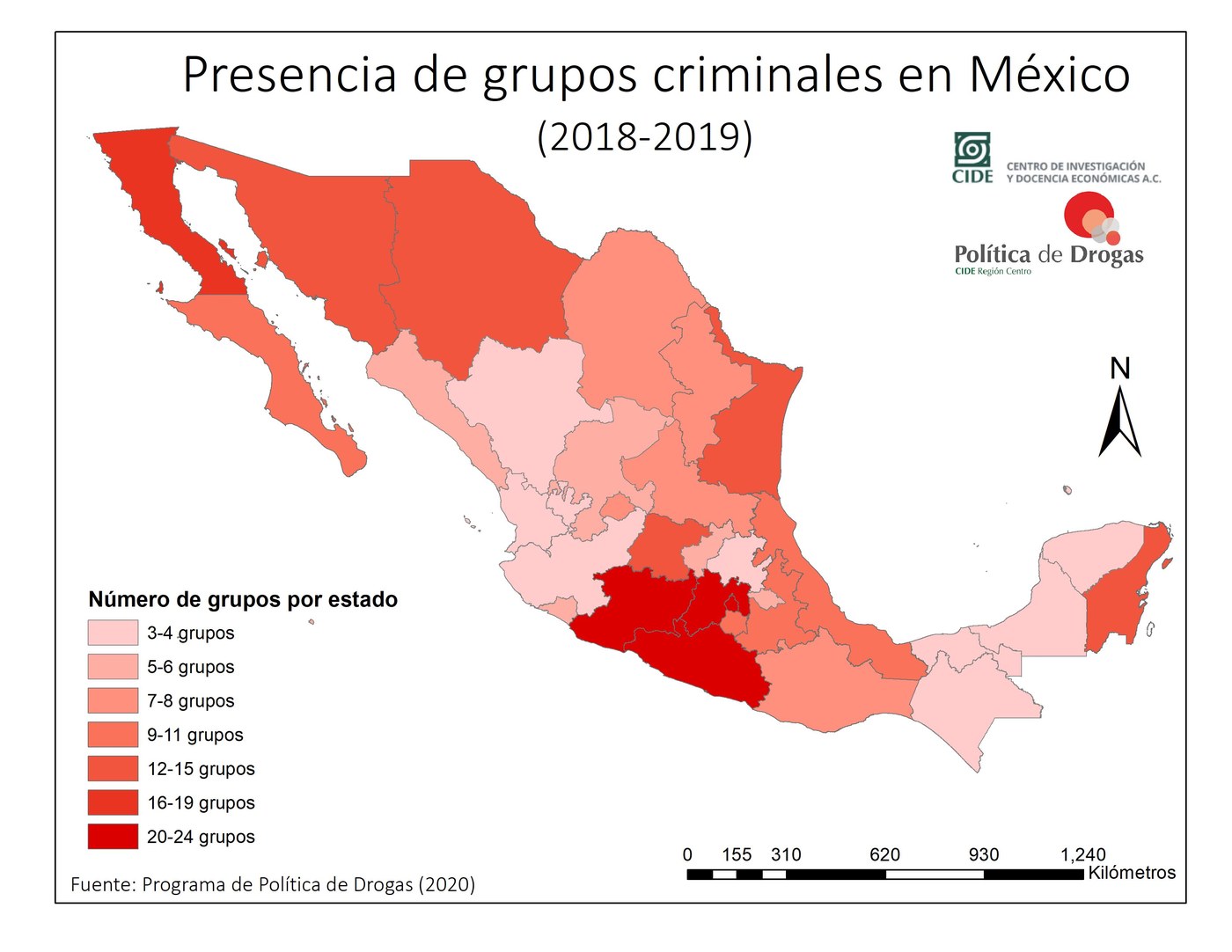
The CIDE-PPD database was assembled from more than 150 sources (local and national news outlets, official government conferences, citizen reports, and social media posts) and required each criminal group to appear in at least three independent sources (the average across the dataset) to be included. To distinguish active operating presence from rumor, the team only counted reports that came with concrete violence indicators: executions accompanied by narcomessages, narcobanners, recorded confrontations, and threat videos. The product is a state-by-state map of which organizations operate where.
What the map shows
148 Distinct criminal groups documented across Mexico in 2018–2019
31/32 States with documented CJNG presence (the U.S. DEA reports only 25)
17 Of the 148 groups are splinter organizations broken off from larger cartels
National reach. The Cartel Jalisco Nueva Generación (CJNG) is documented operating in 31 of 32 states, six more than the DEA reports. The Pacific Cartel reaches 16 states; the Gulf Cartel and Sinaloa Cartel each operate in 15.
Territorial concentration. A handful of states host a high concentration of distinct criminal groups: Guerrero (24 groups), Michoacán (23), and the State of Mexico (22). At the other extreme, Nayarit (3), Yucatán (4), and Zacatecas (5) host the fewest. The geographic clustering of group multiplicity along the Pacific corridor and central Mexico is one of the clearest patterns in the data.
Splinter ecology. Of the 148 groups, 17 are confirmed splinters of larger organizations; the splintering is not always orderly. The CJNG’s founder, Nemesio Oceguera, was originally a Sinaloa Cartel operator. Nazario Moreno, who founded the Knights Templar, came out of La Familia Michoacana. The criminal underworld is constantly fragmenting, recombining, and reabsorbing.
Armed wings. Six major cartels collectively control 34 armed wings, about six per organization. The Sinaloa Cartel alone commands 11 distinct armed branches, the largest such structure in the dataset.
Strategic alliances. In Guanajuato, three rival cartels (Sinaloa, Los Zetas, and the Gulf Cartel) formed a coalition known as “Los Cárteles Unidos” specifically to push back against CJNG expansion. Alliances form not from ideology but from the pressure of a third party.
The violence paradox
It is tempting to assume that the states with the most criminal groups must be the most violent. The data don’t support that assumption. In 2018, Mexico’s national homicide rate was 28.3 per 100,000, but the country’s most violent states (Colima, Baja California, and Chihuahua, with rates between 71.3 and 87.5) do not host the highest count of criminal organizations. Conversely, Guerrero (24 groups) and Michoacán (23) are violent but not the most violent.
This suggests that lethal violence depends less on how many organizations are present than on how brutal they are, how they compete, and what countervailing forces (military presence, historical patterns, territorial monopoly) are at play. A state with two organizations fighting for total control of a port can produce more deaths than a state with twenty cooperating informally.
Why it matters
A national security policy that does not know which groups operate where is a policy designed in the dark. The CIDE-PPD database is not a finished product: its authors flag the need for municipal-level extension as the next step. But it does something the official conversation rarely does: it distinguishes “presence” from “violence” with empirical evidence, and shows that reducing one is not the same as reducing the other. Effective drug policy needs both maps: where the groups are, and what makes their interactions deadly. Treating those as the same question (or not asking either) is how Mexico ended up with 148 organizations and a national debate operating without a shared baseline.