Dependence of COVID-19 Policies on End-of-Year Holiday Contacts in Mexico City
MDM Policy & Practice
Dependence of COVID-19 Policies on End-of-Year Holiday Contacts in Mexico City
El Ángel de la Independencia — Paseo de la Reforma Mexico City · Mexico
The Problem
By December 7, 2020, the Mexico City Metropolitan Area (MCMA), home to more than 20 million people, was the epicenter of Mexico’s COVID-19 crisis, with 344,028 confirmed cases and 28,077 deaths already recorded. With the end-of-year holidays approaching, a critical question faced policymakers: could the city’s hospitals survive a surge fueled by holiday gatherings; and could schools safely reopen in early 2021?
The Approach
We built the Stanford-CIDE Coronavirus Simulation Model (SC-COSMO), an age-structured SEIR model with household- and venue-specific contacts, calibrated to daily case and death data from February 24 to December 7, 2020 (11 Bayesian-estimated parameters, 1,000 posterior samples). We projected outcomes through March 7, 2021 across two holiday-contact levels and four policy combinations: status-quo vs. intensified distancing, schools closed vs. open.
What We Found
0.9M Additional cases with high holiday contacts
97% Chance of exceeding hospital capacity
26,000 Peak hospitalizations
If holiday contacts stayed high, hospitalizations would peak near 26,151 (95% PI 8,318–54,558) on January 25, 2021, overwhelming the city’s 9,667 COVID-specific beds with 97% certainty. Reining in holiday contacts roughly halved the peak to 12,830 on January 31 and dropped the chance of exceeding capacity to 64%. The signal was blunt: under every scenario, MCMA needed at least 2,000 more beds.
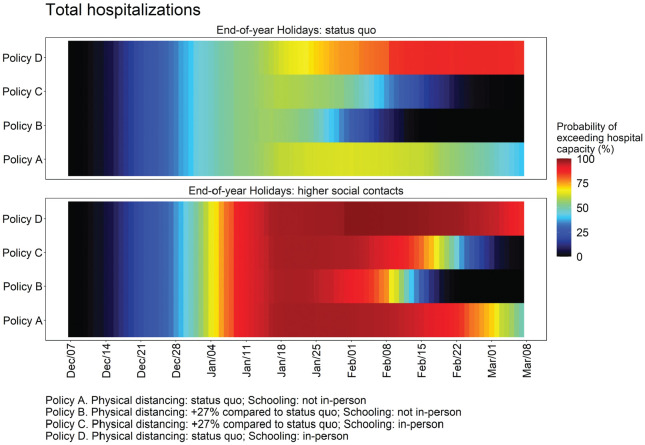 Daily probability of hospitalization demand exceeding COVID-19 capacity in MCMA across policy scenarios (Dec 2020 – Mar 2021).
The Policy Levers
With high holiday contacts and status-quo distancing, the chance of exceeding hospital capacity by early March was 50% with schools closed and 86% open. Intensifying distancing flipped that: exceedance risk fell to under 1% closed and 1.1% open. Reopening schools without tighter community distancing added roughly 376,000 cases; it became feasible once distancing held both in schools and across the community.
Why It Matters
MCMA had to expand hospital capacity under every scenario, but the size of the crisis was a choice. Reopening schools in 2021 hinged on two levers: holiday-season contacts and sustained distancing afterward. Reopening, distancing, and capacity decisions had to be weighed together against their joint health, economic, and social costs.