Birth cohort and age-specific trends in global Helicobacter pylori seroprevalence: A scoping review
The Lancet Regional Health - Americas
Birth Cohort and Age-Specific Trends in Global H. pylori Seroprevalence
Pieter Bruegel the Elder — Children’s Games (1560) Kunsthistorisches Museum · Vienna
The Problem
Gastric cancer remains a leading cause of cancer death worldwide, even as incidence slowly falls. Its primary driver, Helicobacter pylori (a WHO class I carcinogen), has been declining for decades, but the pace varies enormously by region, age, and generation, and until now birth-cohort trends had barely been mapped globally: a blind spot in forecasting future cancer burden.
The Approach
We assembled the most comprehensive picture of global H. pylori seroprevalence to date: 229 publications (250 datasets, including NHANES) spanning 88 countries and every UN region, samples from 1947–2023, more than 375,000 data points. Rather than single snapshots, we tracked infection across age groups and birth cohorts, exposing generational change point-in-time studies miss.
What We Found
229 Publications reviewed
88 Countries reviewed
38.5% Global weighted-mean seroprevalence
Seroprevalence varied more than three-fold: highest in Africa (62·1%) and Latin America & the Caribbean (57·9%), lowest in Oceania (16·4%), with North America (41·1%), Asia (37·7%), and Europe (36·2%) between. Coverage was uneven: Europe (82 studies) and Asia (72) dominated, while Africa contributed under 2% of data despite 12·5% of the world’s population.
The generational signal was consistent everywhere: seroprevalence fell in successive birth cohorts while still rising with age within each. In Japan, predicted prevalence dropped from 60·9% (born 1910) to 6·6% (born 2000); South and North America showed the same decline. Improving childhood living conditions is the likely engine, though the rate differs sharply by region.
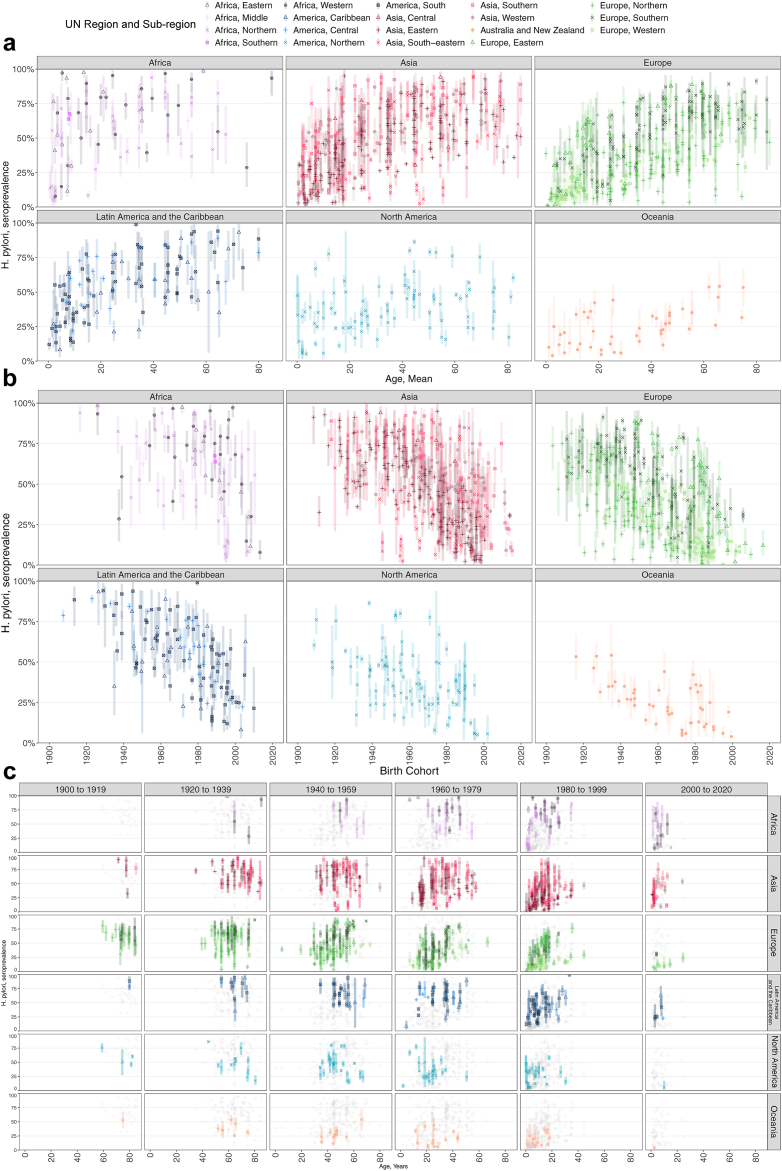 Age- and birth-cohort trends in H. pylori seroprevalence across UN regions, showing declining prevalence in younger generations.
The Americas Gap
The Americas, especially Central America and the Caribbean, had markedly less data, too sparse to resolve trends by both age and cohort. That gap matters: no country in the Americas runs a national eradication program for asymptomatic H. pylori, even as gastric cancer burden there is projected to rise with aging populations and persistently high infection. The weakest surveillance sits where there’s the most to gain from it.
Why It Matters
Younger generations are increasingly free of H. pylori, a hopeful sign for future gastric cancer incidence. But more than a third of people worldwide remain infected, and the Americas’ data gaps leave millions unaccounted for. Folding these age and cohort patterns into epidemiological models would sharpen projections and target prevention where it matters most.