Helicobacter pylori infection in the United States beyond NHANES
The Lancet Regional Health - Americas

H. pylori in the United States Beyond NHANES
Golden Gate at dusk — San Francisco Bay San Francisco · California
The Problem
Gastric cancer in the US mirrors Helicobacter pylori prevalence, the cause of roughly 90% of non-cardia gastric cancers, across racial and ethnic lines. Yet the most recent national estimates come from NHANES data collected in the late 1990s and early 2000s, covering only three racial/ethnic groups: two decades on, outdated and incomplete.
The Approach
We went beyond NHANES: a scoping review of PubMed and Embase (through September 2022) yielding 41 publications and 56,845 individuals, data from 1965–2014 across five SEER groups (Hispanic, NHW, NHB, API, AI/AN). We examined how prevalence differs by age and birth cohort to see whether disparities are narrowing, widening, or holding steady.
What We Found
41 Publications synthesized
56,845 Individuals across all studies
8–94% Seroprevalence range across groups and studies
A clear hierarchy emerged: AI/AN carried the highest seroprevalence, NHW the lowest, Hispanic and NHB in between. Estimates ranged from 8% (NHW children) to 94% (some Hispanic samples); AI/AN clustered at 41–82%. Pooled NHANES surveys (17,249 people) showed 43% among Hispanic/NHB adults versus 16% among NHW, a gap our review confirmed has persisted for decades.
Within every group, seroprevalence rose with age and fell in more recent birth cohorts, though the shape varied by population and the evidence was lopsided: 46% of studies came from the West, 41% from the South, none from the Midwest. No study captured all five groups, and API and AI/AN data clustered in a few locales (Alaska, Hawaii, California), limiting generalizability.
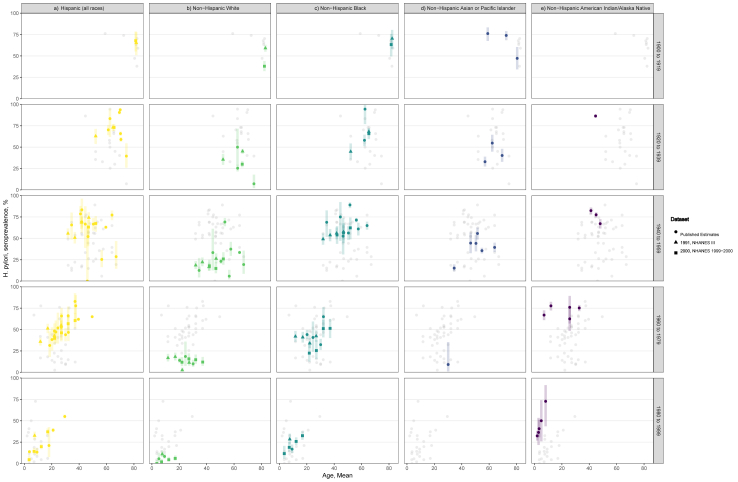 Age and birth-cohort trends in H. pylori seroprevalence by race/ethnicity (Hispanic, NHW, NHB, API, AI/AN). Circles = published studies; triangles = NHANES.
Why It Matters
Persistent disparities in H. pylori prevalence map onto gastric-cancer inequities, yet most evidence is over 20 years old and geographically patchy. Foreign-born status appears to drive some of the highest rates, making immigration and nativity essential variables for future surveillance. Without contemporary data disaggregated by group and origin, targeted prevention for the most-affected communities isn’t possible.