The 2026 Europe report of the Lancet Countdown on health and climate change: narrowing window for decisive health action
The Lancet Public Health

The 2026 Europe Report of the Lancet Countdown on Health and Climate Change
Cairo at sunset — the Nile from above Cairo · Egypt
The Problem
In 1990, the first IPCC report warned of 2°C warming by 2025 without action. Thirty-five years later, the Paris Agreement’s 1·5°C target has a 70% likelihood of being exceeded (2025–29 average), and current policies, fully implemented, still point to 3·1°C by century’s end, far past where health risks rise non-linearly. Europe, the fastest-warming continent, sits on the front line of that gap.
The Approach
This third Lancet Countdown Europe report, from 65 researchers across 46 institutions, tracks 43 indicators across five domains: climate impacts and vulnerabilities, adaptation, mitigation and health co-benefits, economics and financing, and public/political engagement (seven new indicators, three retired), benchmarked against a 1981–2010 baseline.
Coverage targets the 53 WHO Europe countries plus Liechtenstein and Kosovo, though most indicators are computed for the 38 EEA/EU-27 nations with consistent data.
What We Found
254% More heatwave exposure, infants & adults 65+
52 Excess heat deaths per million, per year
297% More dengue-suitable climate conditions
Heat exposure is rising sharply. 823 of 824 monitored regions (99·6%) saw more heat-attributable deaths in 2015–24 than in 1991–2000. Extreme-heat health warnings rose 318%, and unsafe-activity hours rose 88%.
Climate-sensitive infectious diseases are spreading. Dengue transmission suitability rose 297% in 2015–24, helping drive 2024’s record Aedes-borne outbreaks across southern and central Europe. Suitability for West Nile virus, Vibrio, leishmaniasis, and ticks is now tracked too.
Allergies, drought, and food insecurity. The pollen season lengthened by 1–2 weeks. In 2023, over one million additional people faced moderate or severe food insecurity from combined heat and drought, and low-income households were 10·9 points more likely to be affected than middle-income ones: climate inequity, measured.
Labour productivity is being eroded. Higher temperatures cut labour supply by ~24 hours per worker per year (2000–23 vs. 1965–94), with construction and agriculture workers facing the highest heat-injury risk.
The Geography of Risk
Maps from Indicators 1.1.3 (heat mortality) and 1.2.1 (drought, SPEI6): the top panel shows the rise in heat-attributable deaths per million between 1991–2000 and 2015–24 (deepest red ≥120); the bottom shows the change in months of extreme-to-exceptional drought over the same period. Together they make the north–south gradient legible: both hazards intensify moving south and overlap across the Mediterranean.
Southern Europe carries the heaviest combined burden. The regions deepest red for heat mortality are largely the same ones piling up the most drought-months, layering acute heat on top of chronic water stress, agricultural strain, and the food-insecurity and labour losses tracked above. The two maps together turn a continental average into a targeting map: the places that most need heat-health warning systems and drought resilience are identifiable, and they cluster.
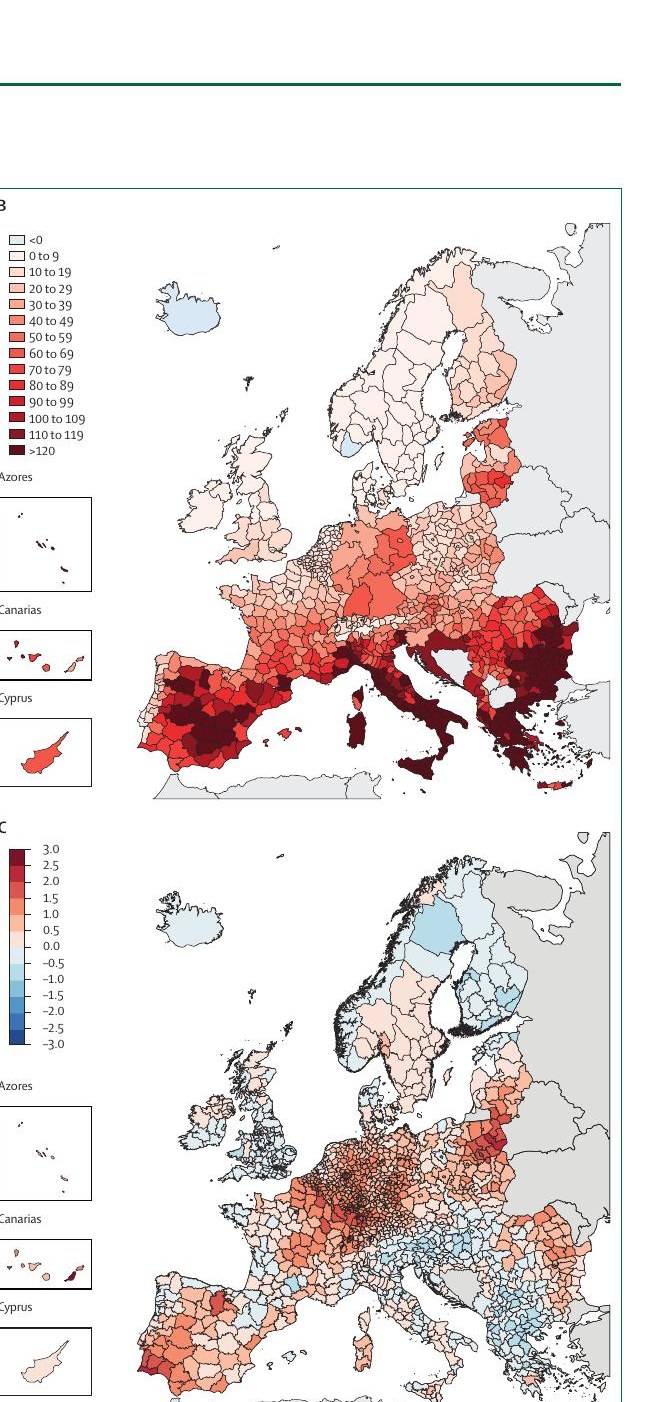 Indicators 1.1.3 & 1.2.1 · The Lancet Public Health
Mitigation: Slow Progress, Fast Trade-offs
Europe’s energy transition is partly underway, partly stalled. Renewables rose to 21·5% of electricity supply in 2023 (up from 8·4% in 2016), coal use fell again, and clean energy investment hit €427 billion (86% above 2015) against €76 billion in fossil fuel investment (32% below). But fossil fuel subsidies also hit a new high of €444 billion, four times 2010 levels, driven by energy-price responses to Russia’s invasion of Ukraine. And solid biomass, the largest renewable source (31% of consumption), brought its own costs: air-pollution deaths from residential burning rose 4%, net tree cover loss rose 80%, and health-care-sector pollution mortality is 24% above 2010.
The pattern is consistent: aggregate progress, with health trade-offs hidden inside the headline numbers.
Engagement is Going the Wrong Way
Scientific literature on climate-health keeps growing, but individual, political, corporate, and media engagement all declined in 2023 (indicators 5.2.1, 5.3, 5.5). One bright spot: climate litigation is emerging as a platform for health arguments. In 2025 the International Court of Justice ruled that states have a binding legal obligation to act on climate change, citing its effects on human and planetary health (indicator 5.6).
Why It Matters
Europe leads the global transition toward a healthier, lower-carbon future, and still falls short of its own targets. The central finding: the health risks of climate change in Europe are no longer projected, they are measured. Heat deaths, vector-borne disease, food insecurity, and labour losses are all observed and rising. Adaptation can’t substitute for mitigation, and mitigation must accelerate, with explicit attention to distributional harm (low-income households, outdoor workers, older adults) and to trade-offs inside the energy transition (biomass pollution, healthcare emissions, fossil fuel subsidies). The window is narrowing. The case for closing it has never been stronger.