Trends in Helicobacter pylori prevalence, force of infection, and attributable disease burden in China from 1990 to 2023: a systematic review, meta-analysis, and modelling study
Preprint — Preprints with The Lancet (SSRN)
Trends in H. pylori in China, 1990–2023
Beijing — the Forbidden City from Jingshan Hill Beijing · China
The Problem
Helicobacter pylori infects more than 40% of adults worldwide and is the leading infectious cause of gastric cancer, responsible, by IARC’s count, for ~850,000 cancer cases globally in 2020, more than HPV, hepatitis B, and hepatitis C combined. Most infections are acquired in childhood, persist for life if untreated, and remain asymptomatic, so a large reservoir of chronic infection accumulates silently and sustains preventable disease burden for decades.
China carries the largest share of that burden. It hosts the largest population living with H. pylori and accounts for roughly 37% of global incident gastric cancer cases (2022). Designing screening and treatment policy requires more than a single pooled prevalence estimate: it means understanding how prevalence varies by age, calendar period, and birth cohort, and how those patterns translate into preventable disease. Existing meta-analyses for China did not provide that resolution.
The Approach
This study reconstructs age-, period-, and cohort-specific H. pylori infection in mainland China from 1990 to 2023 by jointly modelling three data types (current-infection prevalence, seroprevalence, and ever-infection prevalence) within a unified Bayesian framework. The pipeline:
- Systematic review of studies reporting H. pylori prevalence in China, with age-stratified extraction (181 studies in the final Bayesian fit).
- Random-effects meta-analyses to identify age-period and age-birth-cohort prevalence patterns.
- Bayesian catalytic model to estimate the age-specific force of infection (FOI) and prevalence across age and calendar time, accounting for diagnostic misclassification, antibody waning, and period-varying treatment dynamics.
- Attributable burden calculation combining modelled prevalence with relative risks from the China Kadoorie Biobank to compute the population attributable fraction (PAF) and the number of gastric cancer (cardia and non-cardia) and peptic ulcer disease cases attributable to H. pylori in 2023.
Uncertainty is propagated end-to-end, so the attributable-burden estimates carry the modelled credible intervals.
What We Found
36·3% H. pylori prevalence in China, 2023
70·1% Population attributable fraction, non-cardia cancer
340–370k Gastric cancer cases attributable to H. pylori
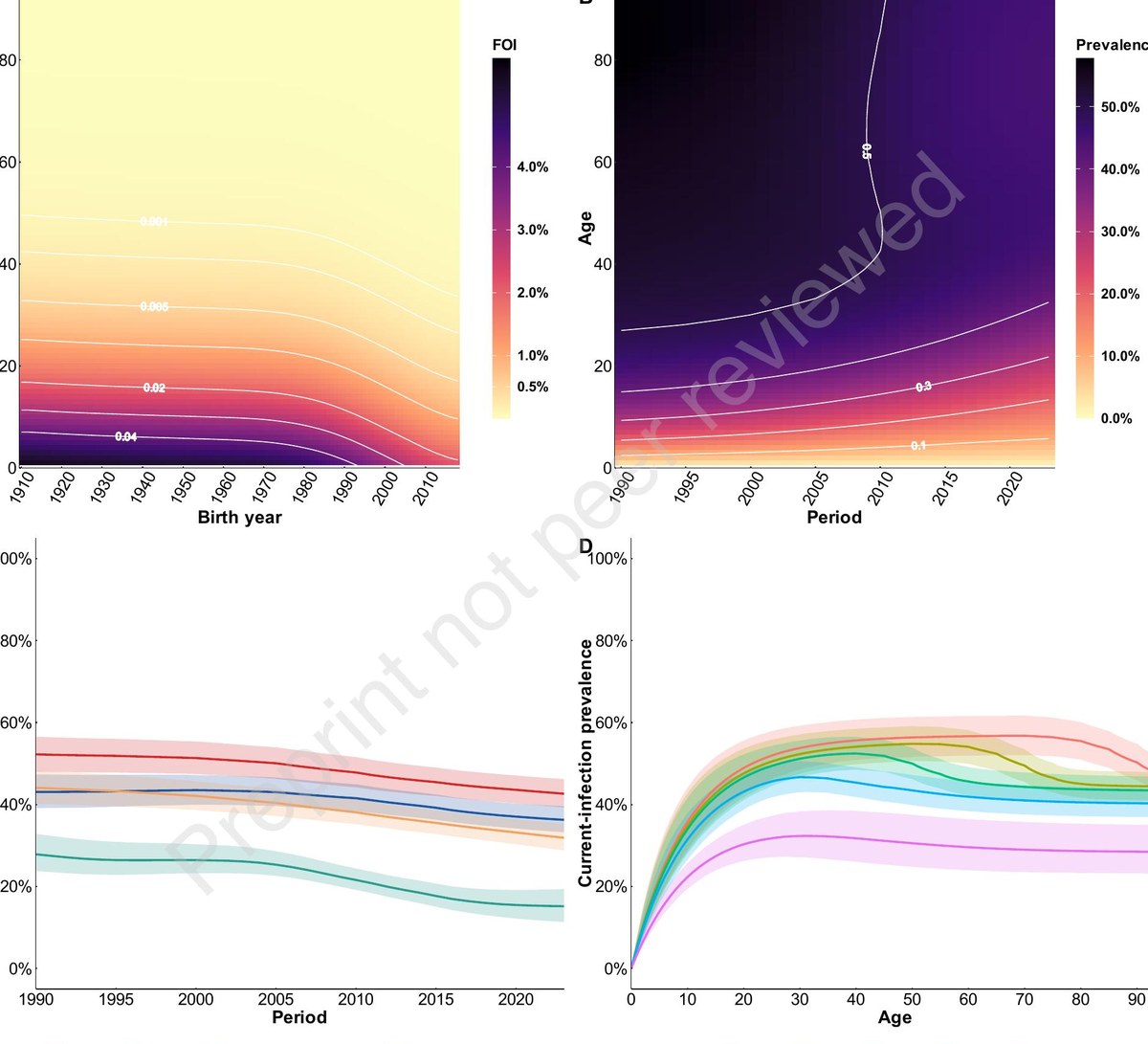
Childhood acquisition has fallen sharply for post-1980 cohorts. The Bayesian model identifies a clear reduction in force of infection among individuals born after 1980, almost certainly a downstream effect of China’s post-1978 reform-and-opening policy, which drove rapid improvements in water supply, sanitation, household crowding, and hygiene. Modernization, in other words, reshaped H. pylori transmission dynamics even before targeted medical interventions reached scale.
But population prevalence has barely moved. Despite that drop in childhood infection, overall population prevalence changed only modestly between 1990 and 2023: from 43·1% to 36·3%. The reason is structural: gastric cancer and peptic ulcer risk are concentrated at older ages, demographic ageing increases the contribution of the older, highly-infected cohorts, and the gains from reduced childhood acquisition are arriving slowly.
The attributable burden remains very high. In 2023, H. pylori contributed an estimated 70·1% of non-cardia gastric cancer cases (95% UI 51·4–82·4) and 49·4% of cardia cases (20·5–70·7), corresponding to 340,000–370,000 gastric cancer cases and 160,000–210,000 peptic ulcer cases in that single year. The absolute burden has changed little over three decades.
Top row. Bayesian-modelled force of infection (panel A) and prevalence (panel B) of H. pylori in China by age and calendar/birth year. The lower-left of panel A (high FOI in young children of older birth cohorts) fades sharply for cohorts born after ~1980. Bottom row. Modelled current-infection prevalence over time (panel C) split by age group (adults vs children) and across age (panel D) by birth cohort. Adult prevalence is stubbornly stable around 40%; childhood prevalence (green) has been falling steadily.
Why It Matters
The optimistic narrative (prevalence is falling, the problem is solving itself) is not what the data say. Childhood FOI is falling, yes; but the absolute burden of H. pylori-attributable gastric cancer and peptic ulcer disease in China remains substantial and is unlikely to decline rapidly without active intervention. Decades of accumulated infection in older cohorts, combined with population ageing, lock in a large preventable disease burden that modernization alone will not erase. The findings support (and quantify) the case for organized screen-and-treat strategies, including family-based approaches consistent with recent international and Chinese expert consensus. The age-period-cohort estimates produced here are also the kind of inputs decision-analytic models need: they identify which cohorts currently carry the highest infection burden, project the downstream health effects of screening at different ages, and estimate the eligible population under each strategy. The modelling framework is transferable: China is the proof of concept; the next step is application to other high-burden regions.
Cite This Work
Note: This is a preprint. It has not been peer-reviewed and should not be used for clinical or public-health decision-making without that context.