Modeling the impact of mass testing and eradication strategies of Helicobacter pylori in the United States
Preprint — The Lancet Regional Health – Americas (SSRN)
Mass Testing and Eradication of H. pylori in the US
Jean-Léon Gérôme — Pollice Verso (1872) Phoenix Art Museum · Phoenix
The Problem
Helicobacter pylori is the strongest known risk factor for gastric cancer, yet no mass eradication strategy has ever been attempted in the United States. Countries like Japan, Taiwan, and Colombia have implemented antibiotic-based screening programs, but the long-term effects on antibiotic resistance remain poorly understood: US resistance rates to clarithromycin, levofloxacin, and metronidazole already exceed 30%.
The Approach
We built an age-structured, race and ethnicity-stratified SIS dynamic transmission model of H. pylori in the US, calibrated to force of infection estimates from NHANES using Bayesian methods (IMIS algorithm). We simulated four hypothetical one-time test-and-treat strategies: treating all adults 18+, all adults 40+, and targeted versions of each focusing on Hispanic and non-Hispanic Black populations, the groups with the highest prevalence.
What We Found
13.4% Prevalence reduction, 18+ strategy
10.3% More antibiotic-resistant strains
4 Testing strategies compared
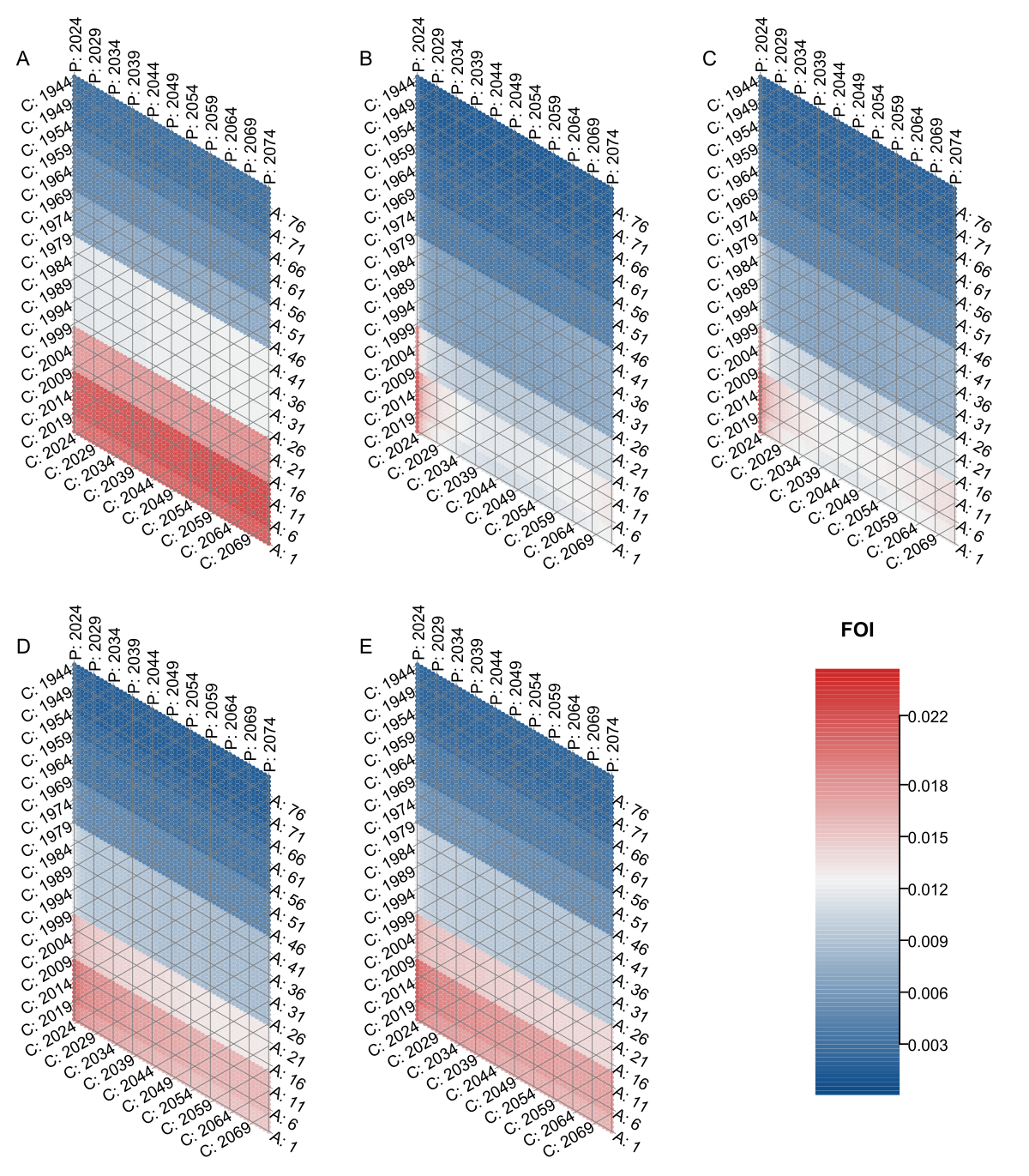
Testing and treating everyone 18+ achieved the largest prevalence reduction (13.4%, 95% PI: 11.2–15.4%), but at the cost of increasing antibiotic-resistant strains by 10.3% (95% PI: 8.1–12.5%). Targeted strategies for Hispanic and NH Black populations reduced overall prevalence by 7.7% while producing smaller increases in resistance among untargeted groups. No strategy eradicated H. pylori: resistant strains grew after every intervention, and without sustained efforts, prevalence rebounded.
Force of infection (FOI) hexamaps for the Hispanic population by age, period, and cohort under each strategy: A) status quo; B) test-and-treat 18+; C) targeted 18+; D) test-and-treat 40+; E) targeted 40+. Red indicates higher FOI; blue indicates lower. Strategies reduce FOI initially, but transmission re-emerges over time.
Why It Matters
Mass test-and-treat strategies can substantially reduce H. pylori prevalence in the US, but every strategy increases antibiotic resistance. Targeted strategies offer the best path to reducing health disparities with smaller resistance trade-offs, but sustained, multi-drug approaches will be essential to prevent resistant strains from undermining the gains.